SrI: SrImathE SatakOpAya nama: SrImathE rAmAnujAya nama: SrImath varavaramunayE nama:
< < OrAN vazhi AchAryas – Introduction
In the series of vAzhi thirunAmams composed by appiLLai, let us see the explanation for the vAzhi thirunAmams of OrANvazhi AchAryas.
Glories of periya perumAL
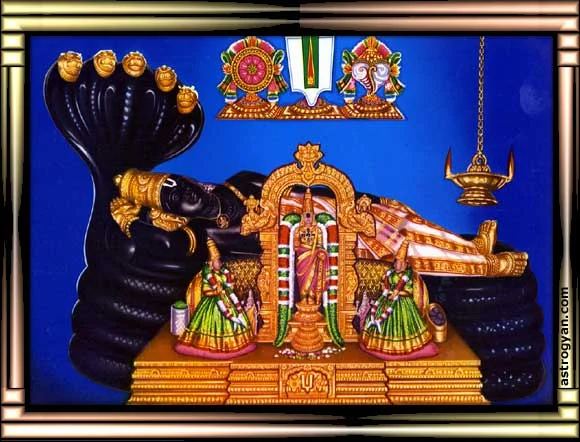
periya perumAL is considered as the first AchArya of our guru paramparA. Following the verse “lakshmInAtha samArambhAm”, the guru paramparA begins with SrIman nArAyaNan, who is the consort of SrI mahAlakshmi thAyAr. We can understand that this SrIman nArAyaNan is indeed SrI ranganAtha, who reclines in SrIrangam and is known as “periya perumAL”. In SrIvaishNava sampradayam, there is a unique significance for archAvathAram. This is because the quality of saulabhyam (easy accessibility) of emperumAn is fully revealed only in the archAvathAram. The kshEthrams for which AzhwArs sung mangaLAsAsanams came to be famously known as dhivyadhEsams. Among these 108 dhivya dhESams, the foremost is SrIrangam, which is hailed as “bhUlOka vaikuNtam” (SrIvaikuNtam on earth). Generally, emperumAn is glorified as ” ubhaya vibhUthi nAthan” – the Lord of both nithya vibhUthi (the Spiritual Realm) and leelA vibhUthi (the Material Realm). However, a unique glory of SrIrangam is that it is called “thrithIyA vibhUthi” (the Third Realm). thrithIyA vibhUthi refers to a state that is distinct, neither fully merging into paramapadham nor being part of the ordinary samsAram. Even while being in the leelA vibhUthi, SrIrangam possesses the greatness of paramapadham. Hence, it is known as the third realm of emperumAn.
All AzhwArs have performed mangaLASAsanam for this glorious SrIrangam. SrI ranganAthar is called “padhinmar pAdum perumAL” (emperumAn sung by the ten AzhwArs). Similarly, most of the AchAryas in the guru paramparA, starting from ALavandhAr and ending with maNavALa mAmunigaL, lived in SrIrangam. Among them, it is not known whether nAthamunigaL, uyyakkoNḍAr, and maNakkAl nambi lived in SrIrangam. Furthermore, the AchArya, thiruvAimozhip piLLai, who had great devotion to nammAzhwAr, renovated AzhwAr thirunagari and lived there. Therefore, we understand that except for thiruvAimozhip piLLai, nAthamunigaL, uyyakkoNḍAr, and maNakkAl nambi, all the other AchAryas followed the principle of living in SrIrangam throughout their lives. Not only SrIvaishNava AchAryas, but we also see that AchAryas of other sampradhAyams lived in SrIrangam out of their devotion for namperumAL. namperumAL (SrI ranganAthar), who reclines in such a glorious SrIrangam, is celebrated as the foremost AchArya in the OrANvazhi AchArya lineage.
emperumAn’s thirunakshathram is said to be rOhini. Since periya perumAL is identified with krishNa, rOhiNi is taken as his thirunakshathram. Some also say namperumAL’s thirunakshaththram is rEvathi. SrI bhagavath gIthA, directly uttered by krishNa in dhvApara yuga, and the thaniyan “SriSailESa dhayApAthram” which he rendered to honour maNavALa mAmunigaL, are known as the granthams (SrI sUktis) graced by emperumAn. He is famously known as SrI ranganAthar. He is the perumAL who descended from paramapadham with his vimAnam and was worshipped by brahmA in sathya lOka. Later, king of ikshvAku dynasty (sUrya clan) prayed to brahmA and brought this perumAL along with the praNavAkAra vimAnam to ayOdhyA in bhUlOka. All the kings who were born in raghu clan worshipped this perumAL. During SrI rAma avathAram, SrI rAma performed ArAdhana to this perumAL. In SrIvaishNava sampradhAyam, the term “perumAL” specifically refers to SrI rAma. He is called as “periya perumAL” because he, SrIranganAthar was the perumAL worshipped by “perumAL” (SrI rAma). During his pattAbhishEkam (coronation), SrI rAma gifted periya perumAL with the praNavAkAra vimAnam to vibhIshaNAzhwAn and told to worship him. When vibhIshaNzhwAn was traveling from ayOdhyA towards lankA in the south, he reached SrIrangam, which appeared like an island surrounded by the river kAvEri on both sides. To perform his anushtAnams (daily rituals), he placed periya perumAL down. At that time, periya perumAL was delighted by the beauty of the groves in SrIrangam. Immediately, periya perumAL told vibhIshaNa, “You may proceed to your land, lankA. Since I like SrIrangam, I will stay here and my gaze will be towards the South to bless you”. As stated in thirumAlai (“vaNdinam muralum sOlai mayilinam Alum sOlai koNdal mIdhaNavum sOlai kuyilinam kUvum sOlai aNdar kOn amarum sOlai“), sarvESvaran (emperumAn of all the worlds) arrived and manifested in the place – the gardens where the swarm of bees are humming, a muster of peacocks are dancing, the clouds are overhanging and hugging, and a bevy of quails are calling out to each other.
In the vAzhi thirunAmam of such a glorious periya perumAL, the five forms of emperumAn—param, vyUham, vibhavam, archA, and antharyAmi are shown. param (supreme state) refers to the state where emperumAn exists as paravAsudEva in paramapadham (SrIvaikuNtam). VyUham (strategic state) refers to the state where emperumAn reclines on the thiruppARkadal /kshIrAbdhi (the milky ocean). It is from here that emperumAn descends from paramapadham to take his avathArams (incarnations). vibhavam (incarnation) refers to the state where emperumAn takes various avathArams (incarnations) in this world, such as krishNAvathAram, rAmAvathAram, narasimha avathAram, vAmana avathAram etc. In archAvathAram (Deity State), to ensure that his grace continues for future generations, emperumAn manifest himself in the form of deities (idols) in various temples and mutts. This form is known as archAvathAram. In antharyAmi (indwelling state), emperumAn exists as the indweller, hidden within all entities and supporting them from within. These five forms of emperumAn are shown in the vAzhi thirunAmam.
periya perumAL vAzhi thirunAmam
thirumagaLum maNmagaLum siRakkavandhOn vAzhiyE
seyyavidaiththAymagaLAr sEvippOn vAzhiyE
iruvisumbil vIRRirukkum imaiyavarkOn vAzhiyE
idarkadiyap pARkadalai eydhinAn vAzhiyE
aRiya dhayaradhan maganAy avathariththAn vAzhiyE
anthariyAmiththuvamum AyinAn vAzhiyE
perugivarum ponninadup pinthuinRAn vAzhiyE
periyaperumAL engaLpirAn adigaL vAzhiyE
Explanation of periya perumAL’s vAzhi thirunAmam
- thirumagaLum maNmagaLum siRakkavanthOn vAzhiyE – vAzhi thirunAmam begins by establishing emperumAn’s SrIya:pathithvam (being the consort of SrI). He exists for the glory of thirumagaL (periyap pirAtti) and maNmagal (bhUmip pirAtti). This line shows that the pirAttis get their glories because of emperumAn, and emperumAn gets his glories because of the pirAttis. Though he has many consorts, SrIidhEvi, bhUdhEvi, and neeLAdhEvi are considered primary. In the first line, the glories of SrIidhEvi and bhUdhEvi are shown.
- seyyavidaiththAymagaLAr sEvippOn vAzhiyE – “seyya” means “great”. nappinnai pirAtti , born in the cowherd community, worshipped emperumAn. In krishNAvathAram, neeLAdhEvi incarnated as nappinnai pirAtti, SrIdhevi as rukmiNip pirAtti, and bhUmidhEvi as sathyabAmA pirAtti . May emperumAn who is worshipped by nappinnaip pirAtti, live long (pallANdu) !
- iruvisumbil vIRRirukkum imaiyavarkOn vAzhiyE – Here, “iru” not only mean ‘two’, it also means ‘vast’. “ visumbu ” means “AkASa” (sky). Long live SrIman nArAyaNan, emperumAn of the nithyasUris (called imaiyavargaL because they never blink their eyes), who reside in the vast sky (paramapadham). This indicates the “param” state.
- idarkadiyap pARkadalai eythinAn vAzhiyE: -To remove our distress, emperumAn came and reclined in the pARkadal (milky ocean). Before taking vibhava avathAram, he descends from paramapadham to the milky ocean and in line with the words “uRanguvAn pOl yOgu seydha perumAn” (emperumAn who is meditating, while pretending to be sleeping), is constantly contemplating about how to bestow grace and do good for the chEthanas (sentient souls). This is known as the “vyUham” state.
Two profound meanings are presented here: 1. He reclined in the Ocean of Milk so that the sorrows of the souls might be extinguished. 2. emperumAn felt great distress upon seeing the suffering of the chEthana, to alleviate his own sorrow (caused by his compassion for us), he reclined in the Ocean of Milk to plan our salvation.
May that supreme lord live long, (pallANdu) !
- aRiya dhayaradhan maganAy avathariththAn vAzhiyE – Long live emperumAn who incarnated as SrI rAmapirAn, the son of the virtuous dhaSaratha, whose divine qualities were so exceptional that they left all onlookers in awe. This indicates the “vibhavam” state. During SrI rAmAvathAram, he is cherished as the son of dhaSaratha (dhaSarathAthmaja) and chakravarthith thirumagan (prince of the emperor).
- anthariyAmiththuvamum AyinAn vAzhiyE – emperumAn resides as antharyAmi within all objects and guides everyone. By stating that he pervades all souls and all sentient (chEthana) and insentient (achEthana) entities, the fourth state, “antharyAmi” is revealed. May that supreme lord live long, (pallANdu)!
- perugivarum ponninadup pinthuinRAn vAzhiyE – He is reclining in SrIrangam, in the midst of the river kAvEri (also called ponni) which flows with surging floods. This line prays for the eternal glory (pallANdu) of the emperumAn who chose this abode.
- periyaperumAL engaLpirAn adigaL vAzhiyE – vAzhi thirunAmam of periya perumAL (Lord SrIranganAtha) concludes by hailing SrIranganAtha, who acts as our greatest upakAraka (benefactor). Through this vAzhi thirunAmam of periya perumAL, who resides in SrIrangam, the foremost of all dhivya dEsams in the archA (deity form), we understand that SrIranganatha himself is the first AchArya in our guru paramparA (lineage of teachers).
Next, we shall look into the meaning of the vAzhi thirunAmam of periya pirAtti (SrI mahAlakshmi). When experiencing the bliss of periya perumAL, one must experience it along with periya pirAtti, as emperumAn and pirAtti are inseparable.
adiyEn gOvindarAja rAmAnuja dhAsan
archived in https://divyaprabandham.koyil.org
pramEyam (goal) – https://koyil.org
pramANam (scriptures) – http://granthams.koyil.org
pramAthA (preceptors) – http://acharyas.koyil.org
SrIvaishNava education/kids portal – http://pillai.koyil.org