SrI: SrImathE SatakOpAya nama: SrImathE rAmAnujaya nama: Srimath varavaramunayE nama:
Glories of nampiLLai
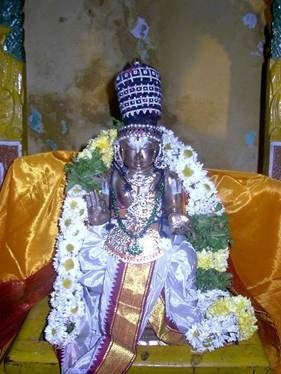
nampiLLai – thiruvallikkENi
nampiLLai’s original name was varadharAjan. He was born in a village called nambUr, located near SrIrangam. Therefore, he is known as nambUr varadharAjan. He was born in the month of kArththigai under the star of kArththigai. thirumangai AzhwAr was also born in the month of kArththigai under the star of kArththigai. He possessed such greatness that it is said that thirumangai AzhwAr himself had returned and incarnated as nampiLLai. Hence, he is called kalikanRi dhAsar. He listened to and enjoyed the kAlakshEpam in the gOshthi of nanjIyar. He is a prominent and main disciple (Sishya) of nanjIyar.
nanjIyar desired to have his 9000 padi vyAkhyAnam transcribed by a person with excellent handwriting. When he inquired about who in his gOshthi could write well, everyone pointed to nampiLLai, saying that nambUr varadharAjan writes beautifully. nanjIyar handed over the 9000 padi palm leaf manuscripts to nampiLLai and instructed him to transcribe them. nampiLLai, known as nambUr varadharAjan, took those palm leaf manuscripts and proceeded to cross the kAveri river to reach his village, nambUr. At that time, a flood had occurred in kAvEri; he tied the manuscripts into a bundle, placed them on his head, and began to cross the river. But the flood washed away the palm leaf manuscripts, and nampiLLai became very distressed. Nevertheless, he went to his village and, meditating upon his AchArya nanjIyar in his mind, he began to write based on what he had heard during the kAlakshEpam with nanjIyar. nampiLLai was a wise scholar; like parASara bhattar he was well-versed in thamizh and samskrutha literature and grammar. He returned to SrIrangam and submitted what he had written to nanjIyar. Upon seeing it, nanjIyar was filled with wonder. This was because all the vyAkhyAnams that were in the original manuscript had been written using more beautiful words. nanjIyar remarked, “yAnaikku kOlam seydhadhu pOlE” (it is like decorating an elephant). That is to say, just as an elephant is inherently beautiful but looks even better with decoration, nanjIyar meant that his own vyAkhyAnams had been further beautified. When he questioned nambUr varadharAjan about it, he recounted what had happened. Hearing this, nanjIyar felt extremely proud and, with supreme bliss, called out “vArum nampiLLaiyE !” (meaning: vArum – come (indicates honorific), my son) and embraced him.
We learn that just as huge crowd gathered for namperumAL’s procession, a equally huge crowd gathered for nampiLLai’s kAlakshEpam also, making everyone wonder, “nampiLLai gOshtiyO namperumAL purappAdO” (is this nampiLLai’s gOshti (assembly) or namperumAL’s procession?” The era of nampiLLai is referred to as “nalladik kAlam” (the era of good times). We learn that during the period of nampiLLai there was no hindrance to the performance/execution of matters related to emperumAn – bhagavath vishayam flourished without any obstacles. It is that once periya perumAL started to get up from his AdhiSEsha paryankam (bed) to listen to nampiLLai’s kAlakshEpam; the thiruviLakku pichan (a SrIvaishNava who took care of the lamps and its lighting in the sannidhi) stopped him by saying, “dhEvarIr ezhundhu varakkUdAdhu. archchAvathAraththil nIr appadiyE thAn irukka vENdum” (You must not get up in your archAvathAra form, you must remain exactly as you are) and made him recline again. We understand this incident from the history. Later, he also received the divine name ‘lokAchArya’. Once, kandhAdaith thOzhappar offended nampiLLai but later he repented and wondered, saying “What a teacher for world he is!” (enna ulagAriyanO) and bestowed the title ‘lokAchArya’ upon him. Furthermore, we learn that naduvil thiruvIdhip piLLai also offended him, later felt regret, and became his Sishya. Thus, it can be seen that many AchAryas held great affection for nampiLLai and surrendered at his feet.
nampiLLai vAzhi thirunAmam
thEmaruvum sengamalath thiruththALgaL vAzhiyE
thiruvaraiyil pattAdai sErmarungum vAzhiyE
thAmamaNi vadamArvum purinUlum vAzhiyE
thAmaraik kai iNaiyazhagum thadambuyamum vAzhiyE
pAmaruvum thamizhvEdham payil pavaLam vAzhiyE
pAdiyaththin poruLthannaip pagarnAvum vAzhiyE
nAmanudhal madhimugamum thirumudiyum vAzhiyE
nampiLLai vadivazhagum nAdORum vAzhiyE
nampiLLai vAzhi thirunAmam – Explanation
thEmaruvum sengamalath thiruththALgaL vAzhiyE – May the divine feet of nampiLLai, which are like honey-dripping red lotus flowers, live long (pallANdu)!
thiruvaraiyil pattAdai sErmarungum vAzhiyE – May the beauty of the silk cloth elegantly worn by nampiLLai around his waist, live long (pallANdu)!
thAmamaNi vadamArvum purinUlum vAzhiyE – nampiLLai wears thulasi garlands, lotus bead garlands, and the pUnUl (divine sacred thread on his chest); may all of them live long (pallANdu)!
thAmaraik kai iNaiyazhagum thadambuyamum vAzhiyE – May his two lotus-like hands and broad shoulders live long (pallANdu)!
pAmaruvum thamizh vEdham payil pavaLam vAzhiyE – nampiLLai would always recite the thamizh vEdham, thiruvAimozhi, which contains profound pAsurams, with his coral-like lips. In the ‘eedu 36000 padi’ vyAkhyAnam of thiruvAimozhi, of vadakku thiruvIdhip piLLai, all aspects of nampiLLai’s kAlakshEpam are explained clearly without doubt. All the meanings highlighted in other vyAkhyAnams are embedded within this eedu 36000 padi vyAkhyAnam. May the coral-like lips of nampiLLai who is thus reciting the commentary of this thiruvAimozhi, live long (pallANdu)!
pAdiyaththin poruLthannaip pagarnAvum vAzhiyE – ‘pAdiyam’ refers to the SrI bhAshyam composed by emperumAnAr. May the great tongue that explains the meanings of that SrI bhAshyam live long. nampiLLai was a great expert in both samskrutha and thamizh. In his kAlakshEpam, he quoted from Sanskrit texts, Sanskrit grammar, emperumAnAr’s SrI bhAshyam, gIthA bhAshyam, vEdhas, ithihAsas, purANas, Agamas, SrI bhagavath gIthA, smruthi, thirukkuraL, aganAnURu, puRanAnURu and other such literature. Thus, nampiLLai, who has such an excellent tongue and is the chakravarththi (emperor) of kAlakshEpam, live long (pallANdu)!
nAmanudhal madhimugamum thirumudiyum vAzhiyE – May his forehead (nudhal) adorned with thirunAmam, his face like the crescent moon, and his divine head, live long (pallANdu)!
nampiLLai vadivazhagum nAdORum vAzhiyE – May the beautiful form of nampiLLai, day after day, live long (pallANdu)!
AchAriyan sichchan Aruyiraip pENumavan
dhEsArum sichchan avan sIr vadivai – Asaiyudan
nOkkumavan ennum nuNNaRivaik kEttu vaiththum
Arkkum annEr niRkai aridhAm
– as maNavALa mAmunigaL has stated in upadhESa raththina mAlai, an AchArya protects the soul of the Sishya while the illustrious Sishya looks after the body of the AchArya with love and provides all kainkaryams to him. Disciples should love the thirumEni (divine body) of the AchArya deeply. This same point is also highlighted in SrIvachana bhUshaNam. An AchArya is one who liberates the Sishya from worldly matters and shows the means to reach emperumAn. The Sishya should not interfere in the matters related to AchArya’s AthmA. Performing kainkaryam to AchArya is the primary duty of a disciple. According to this verse of maNavALa mAmunigaL mentioned above, it was pinbazhagarAm perumAL jIyar, one of his Sishya, who took complete care of nampiLLai’s physical health. maNavALa mAmunigaL also highlighted his greatness in the following pAsuram in upadhESa rathnamAlai
pinbazhagarAm perumAL sIyar perundhivaththil
anbadhuvum aRRu mikka AsaiyinAl – nampiLLaikkAna adimaigaL sey
annilaiyai nannenjE!
UnamaRa eppozhudhum Or
Like pinbazhagarAm perumAL jIyar, we too should perform kainkaryam to our AchArya. The vAzhi thirunAmam of nampiLLai concludes with the prayer that the beautiful form of nampiLLai, that was nurtured by pinbazhagarAm perumAL jIyar, should live long (pallANdu)!
AzhwAr emperumAnAr jIyar thiruvadigaLE SaraNam
adiyEn govindarAja rAmAnuja dAsan
archived in https://divyaprabandham.koyil.org
pramEyam (goal) – https://koyil.org
pramANam (scriptures) – http://granthams.koyil.org
pramAthA (preceptors) – http://acharyas.koyil.org
SrIvaishNava education/kids portal – http://pillai.koyil.org