SrI: SrImathE SatakOpAya nama: SrImathE rAmAnujaya nama: Sri varavaramunayE nama:
Glories of parAsara bhattar
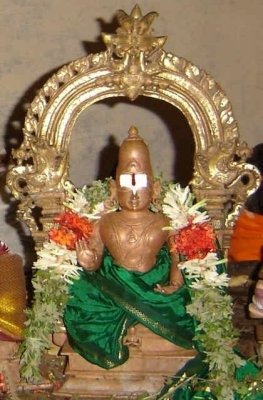
parAsara bhattar (with nanjIyar at his thiruvadi/lotus-feet) – SrIrangam
parASara bhattar was one of the two sons of kUraththAzhwAn. As soon as parASara bhattar was born, emperumAnAr said, “Give this son in adoption to periya perumAL and periya pirAtti. Let him grow as their son”. kUraththAzhwAn did exactly so, and he grew up truly as the son of periya perumAL and periya pirAtti. He came to be known as the son of SrIranganAtha. He incarnated in SrIrangam in the month of vaikAsi under anusham star. Even in his childhood, he excelled with immense spiritual wisdom. While he was playing in the streets of SrIrangam as a young boy, his thiruththagappanAr (respected father), kUraththAzhwAn asked, “Did you not go to the pAtaSAlA (school) to learn santhai (recitation)?” to which he clearly replied, “They are teaching the same lesson today that was taught yesterday”. To that, kUraththAzhwAn said, “Only if you learn the lessons four or five times you will be able to memorise them”. But bhattar replied, “I have already memorized what was taught to me yesterday” and he recited the lessons to demonstrate to him. He has graced us with granthams (works) such as SrIrangarAja sthavam, ashtaSlOkI, SrI guNarathna kOsam, and bhagavath guNa dharpaNam. In ashtaSlOkI he has presented the essence of thirumanthram, dhvayam, and charama slOkam in verse form without explicitly uttering the sacred sounds (syllables). That is, without mentioning the actual words of these exalted manthras, he has beautifully graced us with their meanings in eight verses. SrIrangarAja sthavam is a sthOthra grantham (hymn-based work) containing the meanings of many SAsthrams. SrI guNarathna kOsam reveals the vaibhavam (glory) of periya pirAtti (SrI ranganAyaki). Through bhagavath guNa dharpaNam, he has graced us with a magnificent commentary on SrIvishNu sahasranAmam. He has cited many meanings as authorities for the SrIvaishNava sampradhAyam. Many AchAryas who came after him in the lineage (OrAn vazhi AchAryas) have cited his references as “bhattar nirvAham” (instructions/conclusions). He looked upon SrIranganAtha and SrIranganAyagi thAyAr as his very father and mother. He has shown in his own granthams (works) that pirAtti herself placed him in a thULi (cradle) and raised him. Such was the wisdom and greatness possessed by parAsara bhattar. He performed the kainkaryam of being the purOhitha (priest) for SrIranganAtha. Therefore, he was known as SrIranga purohithar.
parAsara bhattar vAzhi thirunAmam
thennarangar maindhan enach chiRakkavandhOn vAzhiyE
thirunedunthANdakap poruLaich cheppumavan vAzhiyE
annavayal pUdhUran adi paNindhOn vAzhiyE
anavaradham embArukku AtcheyvOn vAzhiyE
mannuthirukkUranAr vaLamuraippOn vAzhiyE
vaigAsi anudaththil vandhudhiththOn vAzhiyE
pannukalai nAlvEdhap payantherindhOn vAzhiyE
parAsaranAm sIr bhattar pArulagil vAzhiyE
parAsara bhattar vAzhi thirunAmam – Explanation
thennarangar maindhan enach siRakkavandhOn vAzhiyE – May parASara bhattar, who attained the distinction of being the maindhan (son) of SrIranganAtha of SrIrangam, live long (pallANdu)!
thirunedunthANdakap poruLaich cheppumavan vAzhiyE – thirunedunthANdakam is the final prabandham graced by thirumangai AzhwAr. In this wonderful prabandham, thirumangai AzhwAr showed the entire essence of the SAsthrams. In periyavAchchAn piLLai’s vyAkhyAnam (commentary), he has stated that within the first three pAsurams all the scriptural meanings are shown. parASara bhattar possessed great mastery over this prabandham. He defeated mAdhavAchAryar (later known as nanjIyar, vEdhAnthi) in a debate using thirunedunthANdakam as the basis. After winning, he came to SrIrangam on the first day of adhyayana uthsavam. When he informed periya perumAL of the victory over vEdhAnthi in mElainAdu (thirunArAyaNapuram area), emperumAn was pleased and commanded bhattar, “Recite the thirunedunthANdakam before us”. We learn that bhattar then recited thirunedunthANdakam before namperumAL. This custom continues even today in SrIrangam, wherein araiyar swAmigaL will recite thirunedunthANdakam on the day before the adhyayana uthsavam. May parASara bhattar, who mastered the meanings of this esteemed thirunedunthANdakam, live long (pallANdu) !
annavayal pUdhUran adi paNindhOn vAzhiyE – In ancient times, fields and ponds existed in srIperumbUthUr. May bhattar, who worshipped the divine feet of rAmAnuja born there, live long. In emperumAnAr’s time, he made the young bhattar recite verses before namperumAL. On seeing bhattar reciting the verses well, emperumAnAr was pleased and he told his gOshti, “parASara bhattar is my equal; he and I are not different”. Therefore, even elderly Sishyas (disciples) like ananthAzhwAn and kidAmbi AchchAn gave the same special respect to bhattar that they gave to emperumAnAr. This line shows: May parASara bhattar who worshipped the divine feet of emperumAnAr who had such affection for him, live long (pallANdu)!
anavaradham embArukku AtcheyvOn vAzhiyE – We know that embAr was bhattar’s AchArya. bhattar held immense respect for both embAr and his father kUraththAzhwAn. Both bhattar and his brother, vEdha vyAsa bhattar, considered both of them as AchAryas, as kUraththAzhwAn explained the meaning of thirumanthram to them. May bhattar, who worshipped embAr throughout his life, live long (pallANdu) !
mannuthirukkUranAr vaLamuraippOn vAzhiyE – bhattar and his brother, vEdha vyAsa bhattar, held great devotion towards their father. Once, when kUraththAzhwAn was giving vyAkhyAnam (explanation) of the thiruvAimozhi 1.2.10 “eN perukkan nalaththu oN poruLeeRila vaNpugazh nAraNan thiNkazhal sErE”, (nArAyaNan is the owner of infinite jIvAthmAs, who has auspicious qualities such as Anandham (bliss) etc. He has unlimited auspicious qualities. Surrender unto the firm lotus feet of that master known as nArAyaNan), which states essence of thirumanthram, he saw his sons in the gOshti and told them, “Go to your AchArya, embAr and learn these meanings”. Our sampradhAya AchAryas possessed such integrity. bhattar and his brother vEdha vyAsa bhattar obeyed the AchArya’s order and left the assembly. After they left, kUraththAzhwAn felt distressed. In line with thiruvAimozhi pAsuram, “minnin nilaiyila mannuyirAkkaigaL”, meaning life is transient like lightning, he feared that something might happen to them before they even reached embAr to learn the meanings of thirumanthram. He immediately called his sons back and gave the upadhESam of the meanings of thirumanthram, in that gOshti right there. Thus, kUraththAzhwAn was also considered an AchArya for bhattar. This line means: May bhattar, who had the capability to narrate the glories of his father, who was born in a place calledkUram, live long (pallANdu) !
vaigAsi anudaththil vandhudhiththOn vAzhiyE – bhattar was born under anusha star in the month of vaikAsi. He was born on anusham star on the day following prapanna jana kUtasthar nammAzhwAr’s birth star vaikAsi visAgam. May he live long (pallANdu)!
pannukalai nAl vEdhap payan therindhOn vAzhiyE – May bhattar, who clearly knew the essence and purpose of prabandhams and fours vEdhas, live long (pallANdu)!
parAsaranAm sIr bhattar pArulagil vAzhiyE – To fulfill a promise to ALavandhAr (to bring glory to parASara muni and vEdha vyAsa muni), emperumAnAr named kUraththAzhwAn’s sons parASara bhattar and vEdha vyAsa bhattar. The vAzhi thirunAmam concludes by wishing that the glory of parASara bhattar, who has such good qualities live in this world for long (pallANdu)!
AzhwAr emperumAnAr jIyar thiruvadigaLE SaraNam
Source – https://divyaprabandham.koyil.org/index.php/2020/12/vazhi-thirunamams-embar-bhattar-tamil-simple/
adiyEn govindarAja rAmAnuja dAsan
archived in https://divyaprabandham.koyil.org
pramEyam (goal) – https://koyil.org
pramANam (scriptures) – http://granthams.koyil.org
pramAthA (preceptors) – http://acharyas.koyil.org
SrIvaishNava education/kids portal – http://pillai.koyil.org