SrI: SrImathE SatakOpAya nama: SrImathE rAmAnujaya nama: Srimath varavaramunayE nama:
<< vadakkuth thiruvIdhip piLLai
Glories of piLLai lOkAchAryar
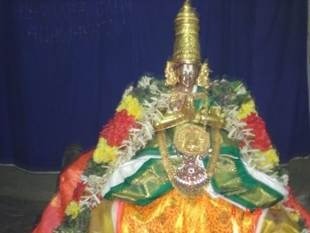
piLLai lOkAchAryar – srIrangam
piLLai lOkAchAryar is celebrated by our pUrvAchAryas as parama kAruNikar (Supremely Merciful). We already know the history of his avathAram. He was born in SrIrangam as the eldest son of vadakkuth thiruvIdhip piLLai. vadakkuth thiruvIdhipppiLLai gave his son the thirunAmam ‘lOkAchAryar’, which is the thirunAmam of his own AchArya, nampiLLai. vadakkuth thiruvIdhip piLLai hailed from the lineage of mudumbai nambi, one of the 74 simhAsanAdhipathis established by emperumAnAr. That is why maNavALa mAmunigaL, in his upadhESa rathna mAlai, refers to piLLai lOkAchArya as “mudumbai aNNal ulagAriyan” (the most auspicious swAmi, lOkAchAryar, being the chief of the city called mudumbai). His thirunakshathram is aippasi thiruvONam. He has graced us the rahasyArthams shown by our elders in eighteen rahasya granthams. piLLai lOkAchAryar was the first to transcribe these rahasya arththams in detail on palm leaves. That is why piLLai LokAchAryar was called ‘parama kAruNikar’ (supreme merciful person).
In olden days, an AchArya would give upadhESam (instructions) of these rahasya arthams (sacred meaning) only to his own Sishya. Thus, the rahasya arththams were taught only within the AchArya Sishya lineage. piLLai lOkAchAryar, out of his parama karuNai (supreme mercy), categorized and transcribed rahasya granthams regarding rahasya thrayam, sampradhAya meanings, and thathva thrayam separately, showing the way for everyone to attain ujjIvanam (salvation). He followed the vratham (vow) of bramhAchArya (celibacy), remained detached from worldly matters, and lived for over a hundred years. He dedicated himself to the growth of SrIvaishNava sampradhAyam by composing many granthams.
During his lifetime, the Mughals invaded SrIrangam. In the archAvathAram (deity form), emperumAn will not break his ‘archA samAdhi’ (silence/meditative state) to try and protect himself. emperumAn has uttered very few words to his best devotees only on rare occasions by breaking his archA samAdhi (silence state). Even though he is paramaSakthan (Almighty), emperumAn has the greatness of appearing aSakthan (powerless) in archAvathAram.
During the mughal invasion, devotees erected a stone wall in front of periya perumAL and carried namperumAL away. Under the leadership of piLLai lOkAchAryar, namperumAL set out and traversed many dhivya dhESams; it took nearly forty-eight years for him to return to SrIrangam. Even when piLLai lOkAchAryar became elderly, he safely brought emperumAn to jyOthishkudi (now called as kodikkuLam) located behind Anaimalai in Madurai and guarded him with great responsibility. Due to old age, right at that place, piLLai lOkAchAryar attained paramapadham (thirunAttiRku ezhundharuLinAr). He thus lived entirely for emperumAn.
Furthermore, in the introduction to SrIvachana bhUshaNam, maNavALa mAmunigaL celebrates piLLai lOkAchAryar as an incarnation of dhEvap perumAL (kAnchIpuram varadharAjap perumAL). In his thaniyan (invocatory verse), it is shown that he is like a rare medicine for those bitten by the snake of samsAram (worldly existence).
piLLai lOkAchAryar vAzhi thirunAmam
aththigiri aruLALar anumadhiyOn vAzhiyE
aippasiyil thiruvONaththavathariththAn vAzhiyE
muththineRi maRaiththamizhAl mozhindharuLvOn vAzhiyE
mUdhariya maNavALan munbudhiththAn vAzhiyE
niththiyam nampiLLaipadham nenjil vaippOn vAzhiyE
nIL vachana bhUdaNaththAl niyamiththAn vAzhiyE
uththamamAm mudumbai nagar udhiththavaLLal vAzhiyE
ulagAriyan padhangaL Uzhithorum vAzhiyE
piLLai lOkAchAryar vAzhi – Explanation
aththigiri aruLALar anumadhiyOn vAzhiyE – aththigiri refers to kAnchIpuram. kAnchIpuram varadharAjap perumAL appeared in the dream of a archaka (priest) from maNappAkkam grAmam (village) near kAnchIpuram and gave some upadhESams (teachings). When emperumAn stopped the upadhESams halfway, the distressed archakar prayed to him; emperumAn said, “Come to SrIrangam. I shall grant you the remaining upadhESams there” and disappeared. maNappAkkaththu nambi arrived in SrIrangam and saw an AchArya performing a kAlakshEpam at kAttazhagiya singar sannidhi. He began to listen intently. maNappAkkaththu nambi was greatly amazed to hear this AchArya’s upadhESam to his Sishyas, it was the continuation of the upadhESam dhEvap perumAL had given to him. He realized that the one performing the kAlakshEpam was piLLai lOkAchAryar. maNappAkkaththu nambi, wondering how the AchArya in SrIrangam knew the continuation of the upadhESam given to him by dhEvap perumAL in kAnchIpuram, entered the gOshthi, performed theNdan (prostration), and asked piLLai lOkAchAryar, “avarO nIr?” (Are you him, the emperumAn?) piLLai lOkAchAryar asked, “Avadhu Edhu?” (Yes. What should be done?). Through this, we learn that piLLai lOkAchAryar was considered an incarnation born with the parama krupai (supreme grace) of dhEvap perumAL. May piLLai lOkAchAryar, who received the anugraham (grace) of dhEvap perumAL, live long (pallANdu)!
aippasiyil thiruvONaththu avathariththAn vAzhiyE – This line shows: May piLLai lOkAchAryar, who was born in aippasi, thiruvONam, same as poigai AzhwAr, live long (pallANdu)!
muththineRi maRaiththamizhAl mozhindharuLvOn vAzhiyE – The rahasya granthams he graced us in thamizh are considered equal to the vEdhas that show the path to mukthi (liberation). May piLLai lOkAchAryar, who graced us with such exalted rahasya granthams, live long (pallANdu)!
mUdhariya maNavALan munbudhiththAn vAzhiyE – May piLLai lOkAchAryar who was born as thamaiyanAr (elder brother) to azhagiya maNavALap perumAL nAyanAr, live long (pallANdu)! azhagiya maNavALap perumAL nAyanAr also remained as a naishtika brahmachAri and like his thamaiyanAr, supported the growth of the SrIvaishNava sampradhAyam. In the wonderful grantham ‘AchArya hrudhayam‘ composed by him, he clearly explained the thiruvuLLam (heart/mind) of nammAzhwAr. He (nAyanAr) also composed vyAkhyAnam for prabandhams like kaNNinuN chiRuth thAmbu, thiruppAvai and amalanAdhi pirAn.
azhagiya maNavALap perumAL nAyanAr reached paramapadham (thirunAttiRku ezhundharuLinAr) a short time before piLLai lOkAchAryar. At that time, piLLai lOkAchAryar placed his charama thirumEni (final, divine body) on his lap and lamented, “Who is there now to explain the meaning of the charama SlOka of the gIthA so well? You have thus departed to paramapadham”. azhagiya maNavALap perumAL nAyanAr was of such greatness that even a wise man such as piLLai lOkAchAryar was moved by sorrow. Generally, in SrIvaishNava sampradhAyam, it is said by elders that one should not grieve when someone reaches paramapadham. Although we rejoice about the greatness of paramapadham and the welcome the soul receives there, it is also said that the world that has lost them will naturally feel distressed. Another incident is mentioned here: when kUraththAzhwAn reached paramapadham (thirunAdu ezhundharuLina samayam), even the all-knowing emperumAnAr cried out. When great bhakthas are lost, no matter how wise a man is, the loss is felt by them. Thus, piLLai lOkAchAryar, who was born as the elder brother to the illustrious azhagiya maNavALap perumAL nAyanAr, live long (pallANdu)!
niththiyam nampiLLai padham nenjil vaippOn vAzhiyE – May piLLai lOkAchAryar, who daily keeps and worships the divine feet of his father’s AchArya, nampiLLai, in his heart, live long (pallANdu)! We know that it was vadakkuth thiruvIdhip piLLai who transcribed nampiLLai’s kAlakshEpams. His sons, piLLai lOkAchAryar and azhagiya maNavALap perumAL nAyanAr, grew up learning the meanings of nampiLLai’s kAlakshEpam through their father. piLLai lOkAchAryar and azhagiya maNavALap perumAL nAyanAr have extensively presented the matters spoken in nampiLLai’s kAlakshEpam in their own granthams. This line shows: May piLLai lOkAchAryar, who worships the illustrious nampiLLai in his mind, live long (pallANdu)!
nIL vachana bhUdaNaththAl niyamiththAn vAzhiyE – piLLai lOkAchAryar has provided all the details in SrIvachana bhUshaNam, based on the commentaries he had heard from nampiLLai’s kAlakshEpam. SrIvachana bhUshaNam is famously known as the “dhivya-SAsthram” (Divine Scripture). Among the eighteen granthams he composed, mumukshUppadi, thathva thrayam and SrIvachana bhUshaNam are the most prominent. Our pUrvAchAryars have arranged for these to be heard as kAlakshEpam. piLLai lOkAchAryar has graced us with SrIvachana bhUshaNam by weaving together the SrIsukthIs (auspicious sayings) of the pUrvAchAryars. In this SrIvachana bhUshaNam, it is shown that “AchArya abhimAnamE uththArakam”, emphasising that one attains mOksha only through the grace of his AchArya. May piLLai lOkAchAryar, who ordained through SrIvachana bhUshaNam the conduct of SrIvaishNavas, live long (pallANdu)!
uththamamAm mudumbai nagar udhiththavaLLal vAzhiyE – Here ‘nagar’ should be understood as ‘lineage/clan’. We know that piLLai lOkAchAryar was born in the vamSa (lineage) of mudumbai nambi, a Sishya of emperumAnAr. May piLLai lOkAchAryar, born in such a noble lineage, who showed the way for the samsAris (people of this world) to attain ujjIvanam (salvation) through his granthams, live long!
ulagAriyan padhangal Uzhithorum vAzhiyE – ulagAriyan refers to piLLai lOkAchAryar. The vAzhi thirunAmam concludes stating that may the thiruvadigaL (divine feet) of piLLai lOkAchAryar, live long as long as time exists (pallANdu)!
AzhwAr emperumAnAr jIyar thiruvadigaLE SaraNam
adiyEn govindarAja rAmAnuja dAsan
archived in https://divyaprabandham.koyil.org
pramEyam (goal) – https://koyil.org
pramANam (scriptures) – http://granthams.koyil.org
pramAthA (preceptors) – http://acharyas.koyil.org
SrIvaishNava education/kids portal – http://pillai.koyil.org